


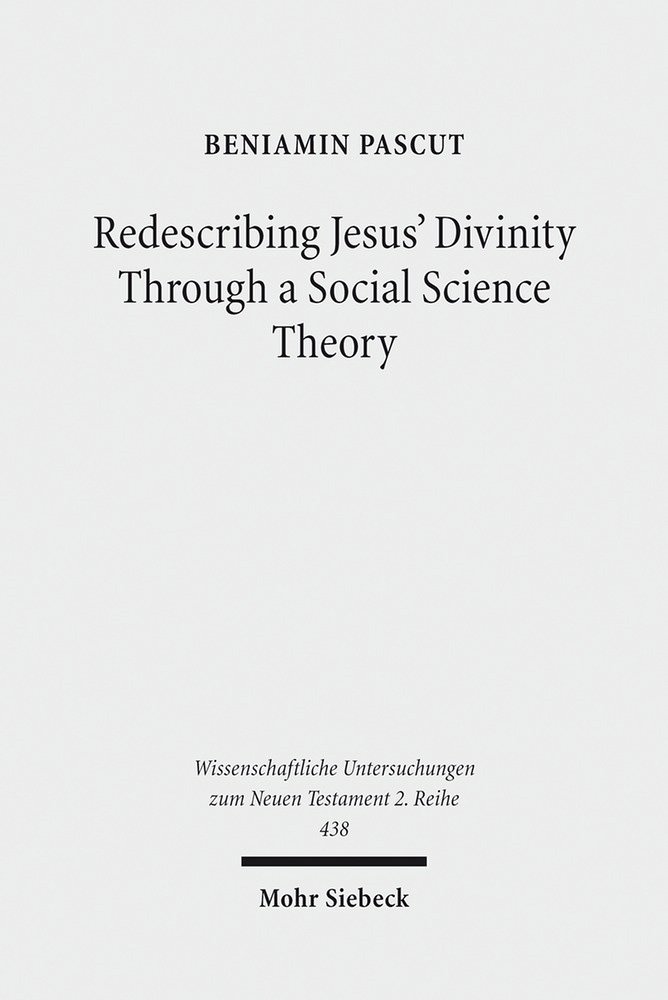
I just finished reading a recent study by Beniamin Pascut, entitled, Redescribing Jesus’ Divinity Through a Social Science Theory: An Interdisciplinary Analysis of Forgiveness and Divine Identity in Ancient Judaism and Mark 2:1-12, WUNT 2/438 (Tübingen: Mohr Siebeck, 2017).
The book is primarily focused on explicating the story of Jesus’ healing of the paralytic in Mark 2. While much could be said about Pascut’s monograph, I wanted to spotlight his discussion of Jesus statement: “Child, your sins are forgiven [aphientai]” (Mark 2:5).
Jesus’ pronouncement uses the passive voice; he does not specify who forgives the man’s sins. As Pascut points out, many scholars argue that since Jesus does not say, “I forgive your sins,” but, “your sins are forgiven,” Jesus probably implies that God forgives the man’s sins. They conclude from this that Jesus himself is not to be seen as the actual agent of forgiveness.
Pascut, however, offers a fascinating overview of other episodes in Mark’s narrative in which the passive voice is used to refer to acts that Jesus himself performs. A few examples:
- The Healing of a Leper. In Mark 1:40, Jesus cleanses a leper, who says, “If you will, you are able to make me clean.” Jesus responds, “I will; be made clean [katharisthēti]” (Mark 1:41). There can be no doubt that the miracle is attributed to Jesus’ will, yet Jesus still uses the passive to perform the miracle.
- The Healing of the Man with a Withered Hand on the Sabbath (Mark 3:5). In Mark 3, Jesus heals a man with a withered hand. Jesus tells the man, “Stretch out your hand” (Mark 3:5). The evangelist then describes the healing using the passive voice, “And he stretched it out [exeteinen], and his hand was restored [apekatestathē]” (Mark 3:5). Pascut points out that that there is no question regarding whether or not Jesus was responsible for the miracle. Controversy surrounded the miracle, but it revolved around whether Jesus should have performed it on the Sabbath. Moreover, the restoration of the man’s hand “should not be understood as a divine passive because the Pharisees used this miracle as an opportunity to arrange to have Jesus killed (3:6). Their plot against Jesus’ life only makes sense if they regarded him as the agent of apekatestathē” (p. 161).
- The Healing of a Woman with a Hemorrhage (Mark 5:27-30). In Mark 5, a woman with a hemorrhage touches Jesus and receives healing. There can be no doubt that Jesus himself is the source of the miracle. Jesus perceives that power had “gone out from him” (Mark 5:30). Yet Pascut observes that, once again, the miracle is described in the passive voice: “she was healed [iastai] of her suffering” (Mark 5:29). Pascut points out that while it is clear that Jesus’ miracles occur through the power of the Spirit, “Jesus is a character who moves on his own, acting as an agent whose own inherent or self-generated power brings healing” (p. 162)
- The Healing of a Deaf-Mute (Mark 7:32-35). In Mark 7, Jesus heals a man deaf man with a speech impediment. Jesus cures the man by saying to him, “Ephphatha,” which the evangelist translates as, “Be opened [ho estin Dianoichthēti]” (Mark 7:34). Once again, the miracle is related with a passive verb. Yet, as Pascut observes, it is clear that Jesus is the agent of the miracle. He notes that “the combination of the verbs describing the actions of Jesus (putting his fingers into his ears, spitting and touching the man’s tongue; 7:33-34) points to the conclusion that Jesus himself is healing the deaf-mute” (p. 162). Moreover, Pascut explains, the crowd responds by declaring, “He has does all things well. He even makes the deaf hear and the mute speak” (Mark 7:35). All of this would seem to underscore that Jesus himself is the agent of the miracle. Indeed, the fact that “power” went “gone out from him” in the story from Mark 5 would make it difficult to imagine the narrative suggests something else is in view.
For these reasons, Pascut raises doubts about whether the passive in Mark 2 – “your sins are forgiven” – should be interpreted as a “divine passive,” that is, as indicating that God forgives the sins instead of Jesus.
Indeed, as Pascut shows, the whole story in Mark 2 would seem to underscore the notion Jesus does something that no other person should be able to do. After declaring the man’s sins forgiven, we read:
But some of the scribes were sitting there, questioning in their hearts, “Why does this man speak like this? He is blaspheming! Who is able to forgive sins except the one God [eis ho theos]?” And immediately Jesus, perceiving in his spirit that they were so questioning within themselves, said to them, “Why do you raise such questions in your hearts?”
(Mark 2:6-8)
Pascut insists that the charge of blasphemy should not be glossed over – Jesus does something that only the “one God” can do. The language here, he argues, is likely “Shema-like” affirmation. In addition, Jesus is depicted as being able to read his critics’ minds.
For Pascut, all of this would seem to suggest that Mark intends to identify Jesus with the God of Israel.
Much more could be said here, but I wanted to highlight this book, which I think makes an important contribution to Gospel studies.